
HYMN FOR PENTECOST 20 Come, sinners, to the Gospel feast

Text: Charles Wesley (1707-1788) Tune: HURSLEY Katholisches Gesangbuch, Vienna 1774

1 Come, sinners, to the gospel feast;
let ev'ry soul be Jesus’ guest.
Ye need not one be left behind,
for God hath bid all human-kind.
2 Sent by my Lord, on you I call;
the invitation is to all.
Come, all the world! Come, sinner, thou!
All things in Christ are ready now.
3 Come, all ye souls by sin oppressed,
ye restless wand'rers after rest;
ye poor, and maimed, disabled, and blind,
in Christ a hearty welcome find.
4 Come and partake the gospel feast,
be saved from sin, in Jesus rest;
O taste the goodness of our God,
and eat His flesh and drink His blood.
4a His love is mighty to compel:
His conqu'ring love consent to feel;
Yield to his love's resistless power,
And fight against your God no more.
5 This is the time, no more delay!
This is the Lord’s accepted day.
Come thou, this moment, at His call,
and live for Him who died for all.
REFLECTION
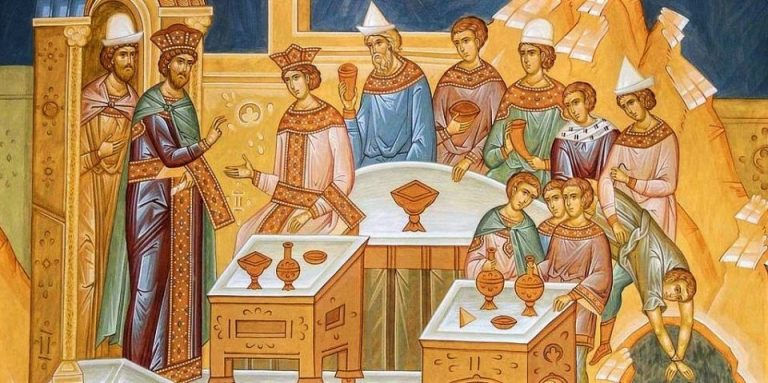
Jesus’ parable on the king’s feast attracts most attention for the guest who has come without the proper garment and is not allowed into the feast. The part where the first invited refuse the invitation rather briskly and shockingly is passed over and the talk is all about why this one is refused entrance. Whatever the required wedding garment was—baptism, good works or faith—is not quite as germane as the fact the wedding guest wants to come on his own terms, an excuse not unlike those initially invited--they all have other things to do. In other words, I and my affairs come first. A rather clear picture of idolatry, against which Scripture rails from the fall in Genesis on to the end.
What we wear is a deeply personal choice, and anyone who has tried to force a child to wear something they don’t want to wear knows how that goes. It is a contest of wills between the child and its parents. Anyone, however, who has ever been invited to a meeting with royals even now knows they have to dress appropriately. At the funeral of King Harald of Norway in September, 2026, everyone who attended the church service or other ceremonies had to wear all black from head to toe or they could not be admitted. And the funny thing is, everybody did. They submitted because they desired to honor the late king.

And while clothes are the issue here, they simply stand for our wills. We do not want to give in to anyone who wants to rule us. What we hold out for is our own will; not the will of God. That is idolatry. Dante in his great poem The Divine Comedy makes clear that for the people in hell, it is their heaven. It is what they wanted. God has said to them, Thy will be done! They would not submit to obeying the God and Father of our Lord Jesus Christ. While I was teaching The Inferno to freshmen who were appalled at the treatment of the inhabitants in the Inferno, it was difficult to teach this lesson. Their call for mercy to the sinners, however, would not have interested the denizens of hell. They preferred their sins to the joys of Paradise.
Sigrid Undset, who won the Nobel Prize for literature in 1928, argued in many places that civilization could not survive if people did not submit dutifully to the requirements of the civilization they had inherited. Arguing for one’s rights over against one’s duty to submit to the demands of their flesh—that is, their children—makes for anarchy, she argued. And we can see that anarchy all around us today. Given the mores of the day, we are taught to be our own gods, hold our own truths and worship ourselves as we will. It doesn’t make for a flourishing culture. The Bible shows us what happens when as Judges 21:25 has it, there was “no king so people did that which was right in their own eyes.” Better to "yield to him," as Wesley has it, than "fight against thy God."
HYMN INFO
Charles Wesley wrote this hymn called “The Great Supper an Invitation to Sinners in 1747 for a collection of Hymns for those who seek and those who have Redemption. It is among one of the more popular of Wesley’s hymns. Unlike many of Wesley’s most well-known hymns, which are drenched with Scriptural references, this is very specific to a Bible story. The editors of hymnals through time, removed a stanza that hints at the guest without a robe--which I added. "And fight against your God no more." For more on Wesley see the information on "Forth in thy name I go." The tune, HURSLEY, comes from a French Huguenot hymnal. The composer is anonymous.
LINKS
Panoplyimaging
Polk Street Methodist Church
Summit Church—contemporary version


Comments